There are times when people ask me whether I am optimistic about the future of education.
Without hesitation, my answer is always yes.
Not because I believe our education system is perfect, but because I have seen what becomes possible when a child is taught in the right way.
I have seen students who were once labelled 'weak' become confident learners.
I have seen children who avoided books begin reading out of curiosity rather than obligation.
I have seen parents who had almost lost hope smile again because their child had finally started believing in themselves.
These experiences remind me that education is never just about academic performance.
At its heart, education is about human potential.
The responsibility of a teacher is not simply to explain a lesson.
It is to help a child discover abilities they did not know they possessed.
That is why I often say that before we teach mathematics, science or languages, we must first teach confidence.
A child who believes in themselves will continue learning long after the lesson has ended.
A child who has lost confidence may stop learning even while sitting in the classroom.
This is why I believe parents have a role that extends far beyond ensuring homework is completed or examination dates are remembered.
Parents know their children better than anyone else.
They notice the excitement in their eyes when they discover something new.
They notice the silence that follows disappointment.
They know when a child has started doubting themselves, even before anyone else does.
For this reason, I believe parents should not measure progress only through report cards.
They should ask questions that marks alone can never answer.
Is my child becoming more curious?
Is my child more confident than they were a month ago?
Do they enjoy learning, or have they started fearing it?
Do they ask questions freely, or do they remain silent because they are afraid of making mistakes?
Sometimes, the answers to these questions reveal far more than any examination result ever could.
The early years of education are especially important.
In my opinion, primary education should not become an endless race for grades.
Those years should be devoted to building the foundations upon which every future achievement depends.
Children should learn honesty before competition, respect before recognition, communication before memorisation, curiosity before comparison and finally confidence before grades.
Because once these qualities become part of a child's character, academic success often follows naturally.
I also believe that teachers deserve greater support than we sometimes acknowledge.
We ask them to shape the future of our children, yet we rarely invest enough in their own professional growth.
The best teachers I have met are not those who believe they know everything.
They are the ones who continue learning.
They reflect on their lessons.
They adapt their methods.
They welcome new ideas.
And above all, they never stop asking themselves how they can become better for the sake of their students.
Perhaps this is the future towards which education should move.
Not towards replacing teachers with technology, but towards empowering teachers with better training, better resources and a deeper understanding of how children learn.
Technology will undoubtedly continue transforming education.
Artificial intelligence, digital classrooms and online learning have already changed the way knowledge is shared across the world.
I myself have had the privilege of teaching students living thousands of miles away without leaving Pakistan.
It is remarkable to think that a child in New York, London, Dubai or Sydney can now learn from a teacher in Islamabad with the click of a button.
Yet despite all these advancements, one thing remains unchanged.
No technology can replace a teacher who believes in a child before the child believes in themselves.
That human connection will always remain at the heart of meaningful education.
When my family and I eventually established
AVENField Tutors, we did so with this belief in mind.
We were not trying to create another tutoring service.
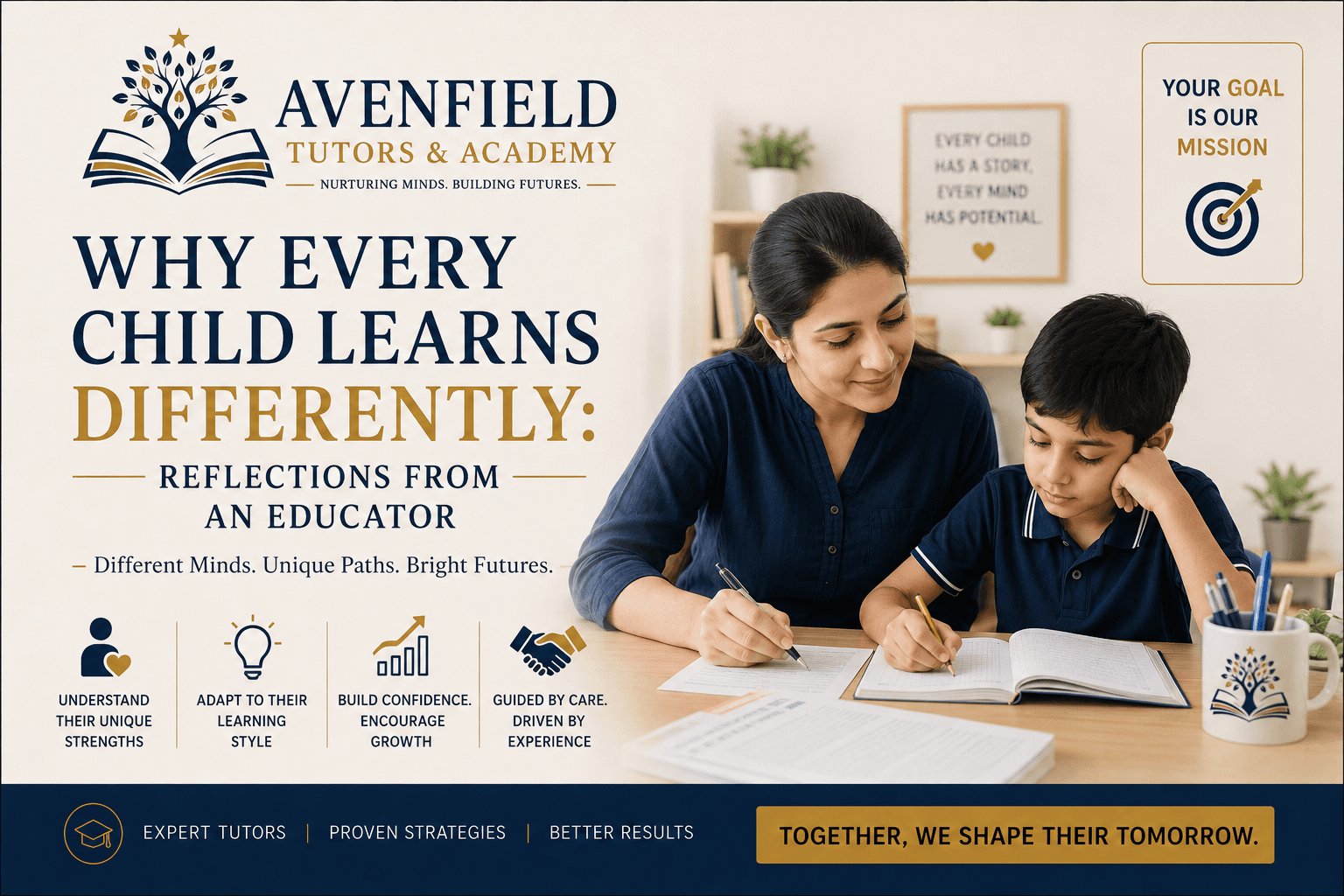
We were trying to build the kind of educational platform that we ourselves had always wished existed—one where students are understood before they are assessed, where teachers continue growing professionally, and where parents are treated as partners in their children's educational journey.
Whether this vision is achieved through AVENField Tutors or through countless other sincere educational initiatives across Pakistan matters less than the vision itself.
Our children deserve educational institutions that place learning above marketing, understanding above memorisation, and long-term character development above short-term academic results.
If more of us begin working towards that goal, I have no doubt that the future of education in Pakistan will be brighter than its present.