
Back to blogCurriculum Choices

O Level vs Matric in Pakistan: Fees, Equivalence and University Admission
AT

Avenfield Tutors Academic Team

10 October 202616 min read
Share
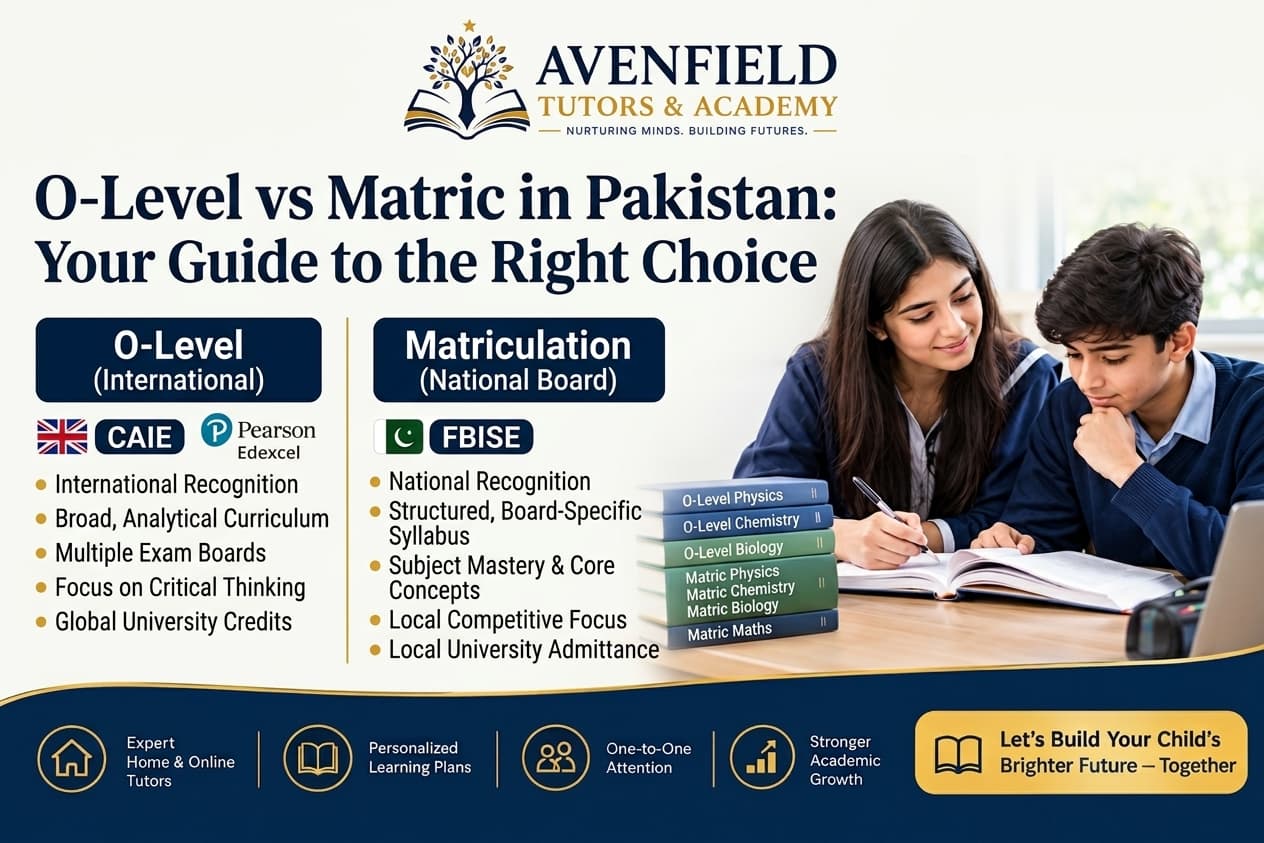
Illustration comparing O Level and Matric education systems in Pakistan with cost, equivalence and university admission icons

O Level vs Matric in Pakistan: What You Are Actually Choosing

Choosing between O Level and Matric is one of the first major education decisions Pakistani parents have to make. Some parents prefer O Level because of its subject choices and examination system. Others choose Matric because it follows the local board curriculum and may be more manageable for their family's budget.
But the decision is not as simple as choosing the system with the better reputation. A student who wants to study medicine in Pakistan has different requirements from someone interested in business, computer science or studying abroad. The school, the student's learning habits, the family budget and the subjects needed for future admission all matter.
Before deciding, it helps to understand how the two systems differ in practice, what they cost and what students need to do after completing their secondary education.
O Level is part of the British education system. In Pakistan, students commonly study Cambridge O Level or IGCSE qualifications. They prepare for individual subject examinations rather than following the exact same curriculum used by Pakistani boards.
Matric, officially the Secondary School Certificate or SSC, is the secondary qualification offered through Pakistan's recognised examination boards. Students study according to their board's syllabus and sit examinations based on the relevant board's requirements.
Both routes can lead to further education in Pakistan. The main difference is how students study, how their performance is assessed, what their families spend and how the qualification is converted for admission purposes. These are general differences, not guarantees about every school. A well-managed Matric school can provide strong teaching, just as an O Level school can vary in teaching quality.

Cost Comparison: What Families Actually Spend

For many families, cost is the deciding factor. However, comparing only the monthly school fee can give a misleading picture. The real cost includes tuition, examination charges, books, extra classes and the time a student may need additional support.
Parents may need to budget for school admission and monthly tuition fees, Cambridge examination fees for each subject, textbooks, revision guides and other learning materials, subject-specific tuition where a student needs additional help, and transport, practical work and other school-related expenses.
Examination costs deserve particular attention because students take several subjects, and the final amount depends on the subjects, examination session and applicable fees. Matric students may also have admission fees, monthly school fees, board registration and examination charges, books and tuition costs. The total can be considerably lower at some schools, especially public schools, although private Matric schools can also charge substantial fees.
There is no single reliable price that applies to every family in Pakistan. School fees vary by city and institution, while examination charges can change between sessions. Before enrolling your child, ask both schools for a written estimate of the total annual cost, including examination fees and any compulsory charges.
Parents can also read our guide to home tutor costs in Pakistan to understand how extra tuition may affect the overall education budget.

Does O Level Guarantee Better Learning?

Not automatically. O Level is often associated with conceptual understanding, application-based questions and independent study. These can be valuable skills, but students still need regular practice, subject knowledge and effective exam preparation.
Matric also covers essential academic concepts. The quality of learning depends on the curriculum, the school's teaching standards, the student's effort and the way lessons are delivered.
Consider two students studying Mathematics. One may understand a concept during class but struggle to apply it to unfamiliar questions. The other may memorise worked examples but become confused when the question changes. Both students need to develop their understanding rather than simply spend more hours reading notes.
The useful question is not which system sounds more prestigious. It is which school and curriculum will help your child build strong subject knowledge, receive appropriate feedback and prepare consistently.

University Admission Routes After O Level and Matric

Both O Level and Matric can provide a route to university, but the admission process is different. Matric students generally proceed through the local education system to intermediate qualifications such as FSc, ICS, FA or ICom, depending on their intended field.
O Level students commonly proceed to A Levels. They may also pursue eligible intermediate routes after obtaining the required equivalence certificate. For Pakistani admissions, O Level students should understand the role of the Inter Boards Coordination Commission (IBCC). The IBCC determines equivalence between recognised qualifications and Pakistan's local education system.
According to the IBCC's published requirements, students taking O Level examinations in Pakistan generally need eight subjects: English, Mathematics, Urdu, Islamiyat, Pakistan Studies and three elective academic subjects. Students who take their examinations overseas may follow different subject requirements.
The required subjects also matter when determining the relevant equivalence group. Students planning to pursue medicine, for example, need to check the prescribed science subjects rather than assuming that any combination of O Level subjects will be sufficient. Read the current requirements directly from the official IBCC British System equivalence guidance before finalising subject choices.

Does IBCC Equivalence Automatically Guarantee University Admission?

No. A recognised qualification is only one part of the admission process. Universities may have specific requirements for subjects, equivalence marks, minimum grades, entry tests and other eligibility criteria. These can differ by institution and programme.
For example, a student applying to a medical programme should check the current subject and eligibility requirements for that programme. A student interested in computer science should verify the mathematics requirements of their intended universities.
Do not select subjects based only on what a school recommends or what other students are studying. Check the requirements for the degree your child may want to pursue.
O Level and A Levels are qualifications within the British education system, and Cambridge qualifications are recognised by many institutions internationally. However, recognition does not mean that every university accepts every qualification or subject combination automatically.
Universities may consider the student's grades, completed qualifications, subject prerequisites, English-language proficiency and other admission requirements. Matric students can also pursue international education, but they may need to complete additional qualifications or meet particular entry requirements depending on the country and university.
If studying abroad is a serious goal, shortlist a few universities in the intended country and check their published admission criteria before choosing a school system. This is more useful than relying on general claims that one qualification is accepted everywhere and the other is not.

Which System Suits Your Child?

There is no universal answer because students learn differently. A student who enjoys reading in English, exploring concepts and practising unfamiliar questions may feel comfortable in O Level. Another student may prefer the structure, teaching approach and examination preparation offered by a particular Matric school.
Language also matters. A student moving into an English-medium environment may need time to become confident with subject terminology and written answers. This does not mean they cannot succeed, but the transition should be planned.
Parents should look at the student's actual needs. Does the student understand concepts or mainly memorise answers? Can they study independently, or do they need regular guidance? Are they comfortable reading and writing academic English? Does the school provide useful feedback when the student makes mistakes? Can the family sustain the expected expenses for the full programme?
A change in curriculum alone will not solve difficulties caused by weak foundations, inconsistent study habits or unsuitable teaching.

O Level Subject Selection: A Decision That Affects Everything After

If you decide on O Level, subject selection deserves careful attention. Some combinations may limit eligibility for particular academic pathways if the required subjects are missing.
Start with the student's likely interests, but do not rely on interests alone. Check the subjects required for the intended A Level combination and future university programmes. For example, students considering medicine should check the current Biology, Chemistry and Physics requirements. Students interested in engineering or computer science should investigate the relevant Mathematics and science requirements for their intended programmes.
Students who are still uncertain about their future can compare possible routes before committing to a subject combination. Our guide on how to choose the right O Level subjects in Pakistan explains this decision in more detail.
It is also worth understanding the transition from O Level to A Level, because subject choices at the secondary stage can affect what a student studies next.

Can Students Switch Between O Level and Matric?

Yes, both routes may be possible, subject to the relevant admission requirements. A student who completes Matric may apply to an A Level institution that accepts their qualification and meets its entry conditions. Similarly, an O Level student may pursue intermediate education after obtaining the necessary SSC equivalence.
However, changing systems can involve differences in subject coverage, teaching methods, terminology and examination formats. A student moving between systems may need to cover gaps in specific subjects. Parents should ask the receiving school or college to assess these gaps before admission rather than assuming that the transition will be effortless.
The decision should also consider what the student plans to study after secondary education. Switching systems simply because one seems more prestigious can create unnecessary academic and financial pressure.

What If Your Child's Marks Are Falling?

Changing from Matric to O Level, or from O Level to Matric, is not always the best first step when a student's marks are falling. Start by identifying the actual problem.
A student might be struggling because they have missed foundational concepts, do not understand the exam question, practise too few past-paper questions or receive little feedback on their mistakes. Sometimes the problem is not the curriculum at all, but an unrealistic study schedule or a lack of individual attention.
Before changing schools or curricula, review the student's recent results and identify the subjects and topics where performance is weakest. A tutor who understands the student's curriculum can help address those gaps. When choosing additional support, parents should look for relevant subject experience, clear explanations and regular progress checks.
Our article on how to choose the right online tutor offers a practical checklist for evaluating a tutor. The goal is not simply to add more tuition hours. It is to find out what is preventing the student from making progress.

Which Is Right for Your Family?

The right choice depends on your child's academic needs, your budget and the educational route you want to keep open.
O Level may suit your family if you prefer the British curriculum and its subject-specific examination structure, you can comfortably manage school, examination and tuition costs, you have checked the required subjects for the student's future pathway, and your child is suited to the teaching and assessment approach offered by the school.
Matric may suit your family if you prefer the Pakistani board curriculum, you want a potentially more affordable route depending on the school, your child's intended academic pathway fits the local system, and you have found a school that offers effective teaching and suitable academic support.
Neither option guarantees higher marks, university admission or career success. The student's preparation, the school's teaching quality and the suitability of the chosen subjects all make a difference.
Before paying admission fees, speak to both schools and ask the following questions: What is the complete annual cost, including examination fees and compulsory expenses? Which subjects will the student study, and what options will be available later? What qualifications will the student need for their intended university programme? How does the school identify and address weak academic performance? What support is available if the student struggles during the first year? What are the requirements for changing to another education system later?
Get clear answers before committing. A well-informed decision now can prevent unnecessary expenses and difficulties when the student reaches the next stage.
AT

Written by

Avenfield Tutors Academic Team

O Level, A Level & Test Preparation Consultants

A team of experienced education consultants based in Islamabad, helping students across Pakistan find qualified, verified tutors for school, college, and competitive exams.

Is O Level equivalent to Matric in Pakistan?▼

Recognised O Level qualifications can be considered equivalent to the Secondary School Certificate through the IBCC, provided the student meets the applicable subject and other requirements. The equivalence process should be checked through the official IBCC guidance.

Is Matric cheaper than O Level in Pakistan?▼

Matric is often the more affordable option, particularly at public schools. However, actual costs depend on the institution, city, examination expenses and additional tuition required. Private Matric schools can also charge substantial fees, so always ask for a written annual cost estimate.

Can O Level students get admission to Pakistani universities?▼

Yes, O Level students can pursue university education in Pakistan through the appropriate academic route. They must meet the relevant equivalence, subject, grade and programme-specific admission requirements. Check the current rules with IBCC and the relevant institution before making an academic decision.

Can a Matric student switch to A Levels?▼

Yes, subject to the admission requirements of the school or college offering A Levels. Students should confirm eligibility and whether any additional academic preparation is needed. A student moving between systems may need to cover gaps in specific subjects.

Does O Level guarantee admission to medical school in Pakistan?▼

Neither system guarantees admission to medical school. Students should select the required subjects, meet the applicable equivalence and academic criteria, and prepare for the relevant admission process. Always verify the current rules before choosing subjects.

Should I change my child's curriculum if their marks are falling?▼

Not immediately. First identify whether the difficulty comes from weak concepts, teaching quality, study habits, subject selection or examination technique. A change may help in some situations, but it should follow a clear assessment of the problem. Our guide on why a child may not be improving despite tuition explains this in more detail.

Ready to put this into practice?

Browse verified tutors on Avenfield and book your first session via WhatsApp – no long forms, no waiting.

💬 Need help? Chat with us