
How to Find the Best Online Tutor in Pakistan: A Complete Guide for Parents and Students
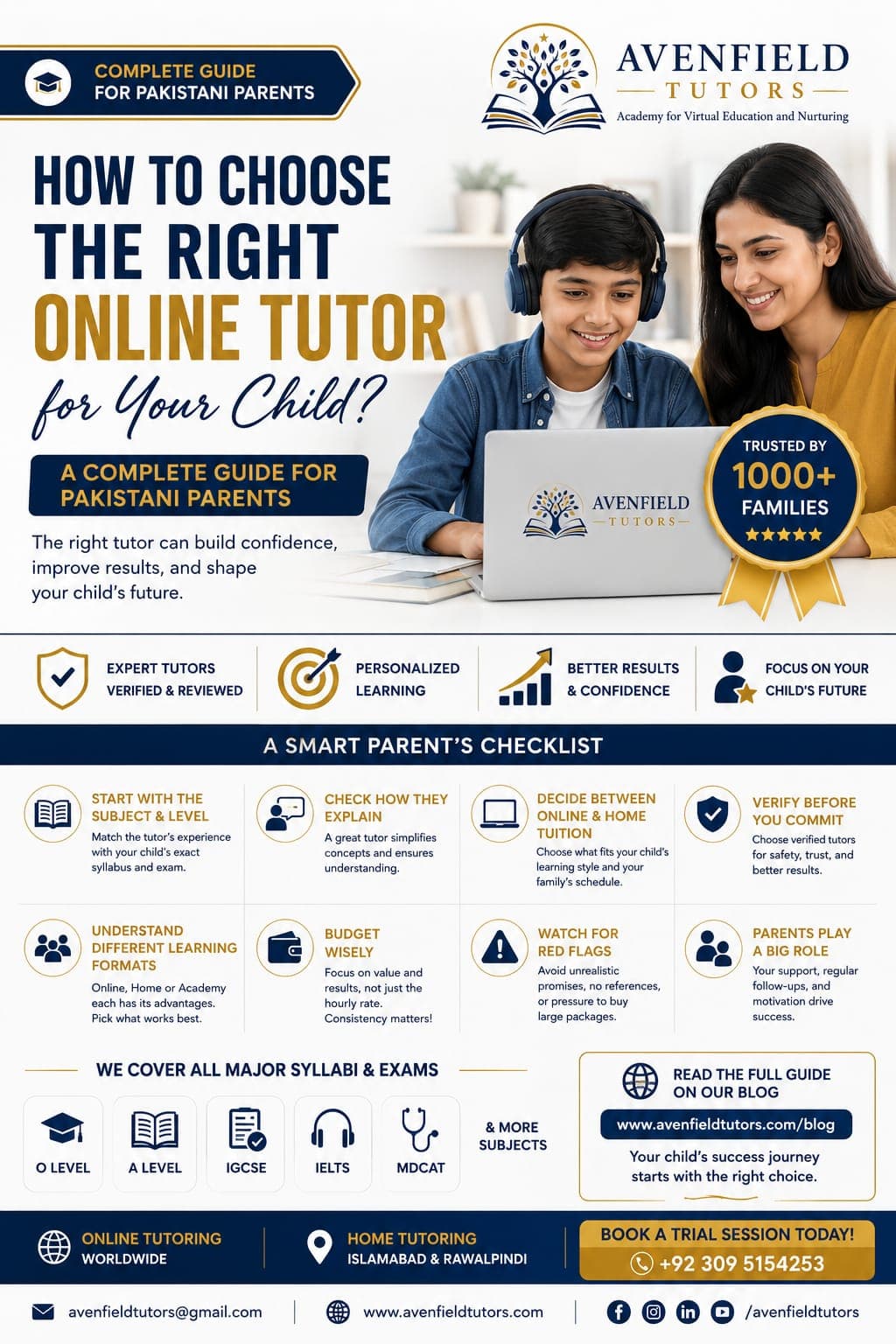
Start With Your Child's Exact Learning Needs
- Subject: Which subject does your child need help with? Be specific Mathematics, Physics, Chemistry, English, or something else?
- Grade or level: Is your child in primary school, O Level, A Level, matric, FSc, or preparing for a competitive exam like IELTS or MDCAT?
- Curriculum or exam board: Does your child follow CAIE, Edexcel, the Federal Board, Punjab Board, or another curriculum? This matters more than many parents realise.
- Current difficulty: Is your child struggling with basic concepts, or are they aiming to improve from a B to an A? Different goals require different teaching approaches.
- Goal: What does success look like? Is it passing a supply exam, achieving a specific grade, or building confidence in a particular topic?
Check the Tutor's Subject and Curriculum Experience
| What to Check | Why It Matters |
|---|---|
| Relevant qualification | Shows subject knowledge |
| Teaching experience | Indicates practical teaching ability |
| Exam-board experience | Familiarity with syllabus requirements |
| Student results | Evidence of effectiveness |
| Trial lesson | Actual teaching fit |
Don't Choose a Tutor Based Only on Price
- Qualifications: Does the tutor have relevant degrees or certifications?
- Experience: How many years have they taught your child's subject and level?
- Lesson duration: Are lessons 45 minutes, 60 minutes, or longer?
- Class frequency: How many lessons per week are recommended?
- One-to-one vs group: Is the tuition one-to-one or in a group setting?
- Trial availability: Does the tutor offer a trial lesson?
Take a Trial Class Before Making a Long-Term Commitment
- Does the tutor ask questions? A good tutor checks understanding regularly rather than just delivering information.
- Can they explain difficult concepts simply? Watch how the tutor breaks down a topic your child finds challenging.
- Does the tutor involve the student? Effective tutoring is interactive, not a lecture.
- Do they identify mistakes constructively? Notice how the tutor responds when your child makes an error.
- Is the lesson structured? Does the tutor have a clear plan, or are they teaching without direction?
- Does the tutor understand the student's current level? A good tutor adapts to where the student is, not where they assume the student should be.
Check Reviews, Qualifications and Tutor Profiles
- Real qualifications: Does the tutor list specific degrees and certifications? Vague claims like "qualified teacher" without details are worth questioning.
- Experience: How long have they been teaching? Have they taught your child's specific curriculum and exam board?
- Subjects and levels: Does the tutor specialise in your child's subject and level, or are they a generalist?
- Reviews: What do other parents and students say? Look for patterns in the feedback.
- Availability: Does the tutor have slots that fit your schedule?
Online Tutor vs Home Tutor: Which One Should You Choose?
- You need a specialist tutor who is not available in your local area
- Your child has a busy schedule and needs flexible session times
- You live in a location where finding qualified tutors is challenging
- Your child is comfortable with technology and can stay focused during online sessions
- Your child is younger and benefits from direct, in-person supervision
- Your child struggles to stay focused during online learning
- Your child prefers face-to-face interaction and hands-on guidance
Choose a Tutor Based on the Subject and Academic Level
Questions Parents Should Ask Before Hiring an Online Tutor
- How many students have you taught at this level? Experience with your child's specific grade or exam level is important.
- Which curriculum or exam board do you teach? A tutor who is familiar with CAIE, Edexcel, or the local board will be better prepared.
- Can you provide a trial lesson? A trial lesson is essential for assessing teaching style and fit.
- How do you track student progress? Regular assessments and feedback help ensure the tutoring is effective.
- What happens if the student misses a lesson? Understand the cancellation policy before committing.
- How frequently do you recommend lessons? The right frequency depends on the student's needs and goals.
- How do you prepare students for exams? A tutor who focuses on past papers and exam technique adds significant value.
- How do you communicate progress to parents? Regular updates keep parents informed and involved.
Red Flags to Watch Out for When Choosing an Online Tutor
- 🚩 Vague qualifications: The tutor cannot clearly explain their qualifications or experience.
- 🚩 Claims to be an expert in every subject: No one is equally strong in all subjects. Specialisation is a sign of genuine expertise.
- 🚩 Avoids trial lessons: A tutor who refuses or avoids a trial lesson may be hiding something.
- 🚩 Immediately sells a package: A tutor who pushes a long-term package before understanding the student's needs is prioritising sales over fit.
- 🚩 Unrealistic guarantees: Promises like "100% guaranteed A*" are red flags. No one can guarantee specific exam results.
- 🚩 Poor communication: If the tutor is difficult to reach or unresponsive before the first lesson, this will likely continue.
- 🚩 No evidence of previous experience: A tutor who cannot provide examples of past students or results may lack real teaching experience.
How to Find a Tutor on Avenfield Tutors
- Browse tutors: Start by exploring the verified tutors directory.
- Filter according to subject, level, and location: Narrow down your options to find tutors who match your specific needs.
- Review tutor profiles: Read about each tutor's qualifications, experience, and teaching approach.
- Compare relevant tutors: Compare their expertise, availability, and rates to find the best fit.
- Contact and book a suitable tutor: Reach out directly through the platform and schedule your first session.
Written by
Avenfield Tutors Academic Team
O Level, A Level & Test Preparation Consultants
A team of experienced education consultants based in Islamabad, helping students across Pakistan find qualified, verified tutors for school, college, and competitive exams.
Looking for expert tutoring in these subjects?
What is the best way to find an online tutor in Pakistan?▼
The best way to find an online tutor in Pakistan is to use a verified platform like Avenfield Tutors, where tutors are vetted before they join. Define your child's needs clearly, review tutor profiles, check their experience with your child's curriculum, and always take a trial lesson before committing to regular sessions.
How much does an online tutor cost in Pakistan?▼
Online tutor rates in Pakistan typically range from PKR 1,000 to 4,500 per hour, depending on the subject, level, and the tutor's experience. Online tutoring is often more affordable than home tuition because the tutor does not need to travel. For a detailed breakdown, see our home tutor cost guide.
Is online tutoring effective for O Level and A Level students?▼
Yes, online tutoring is highly effective for O Level and A Level students. Many Pakistani students have successfully prepared for Cambridge examinations through online tutoring, which offers access to specialised tutors who may not be available locally. The key is to choose a tutor who is familiar with the CAIE or Edexcel syllabus and who uses interactive teaching methods.
Should I choose a tutor based on qualifications or experience?▼
Both qualifications and experience matter, but experience with your child's specific curriculum and exam board is often more important than a qualification alone. A tutor with a relevant degree and years of experience teaching O Level or A Level is likely to be more effective than a tutor with a higher qualification but no teaching experience.
Should my child take a trial class before choosing a tutor?▼
Yes. A trial class is the best way to assess whether a tutor is the right fit. It allows you to observe their teaching style, how they interact with your child, and whether your child actually learns during the session. Never commit to a long-term arrangement without first experiencing a trial lesson.
How often should my child have online tutoring sessions?▼
The frequency of online tutoring sessions depends on your child's needs and goals. For students who are preparing for exams, 2-3 sessions per week may be appropriate. For students who need ongoing support, 1-2 sessions per week is often sufficient. A good tutor will recommend a schedule based on your child's current level and target goals.
How do I choose a tutor for a specific subject?▼
To choose a tutor for a specific subject, look for someone who specialises in that subject at your child's level. Review their qualifications, teaching experience, and familiarity with the relevant exam board. For example, a Mathematics tutor should have a strong background in mathematics and experience teaching the syllabus your child follows.
Ready to put this into practice?
Browse verified tutors on Avenfield and book your first session via WhatsApp – no long forms, no waiting.