
Back to blogCurriculum Choices

How to Choose the Right A Level Subjects in Pakistan: A Practical Guide for Students and Parents
AT

Avenfield Tutors Academic Team

1 October 202615 min read
Share
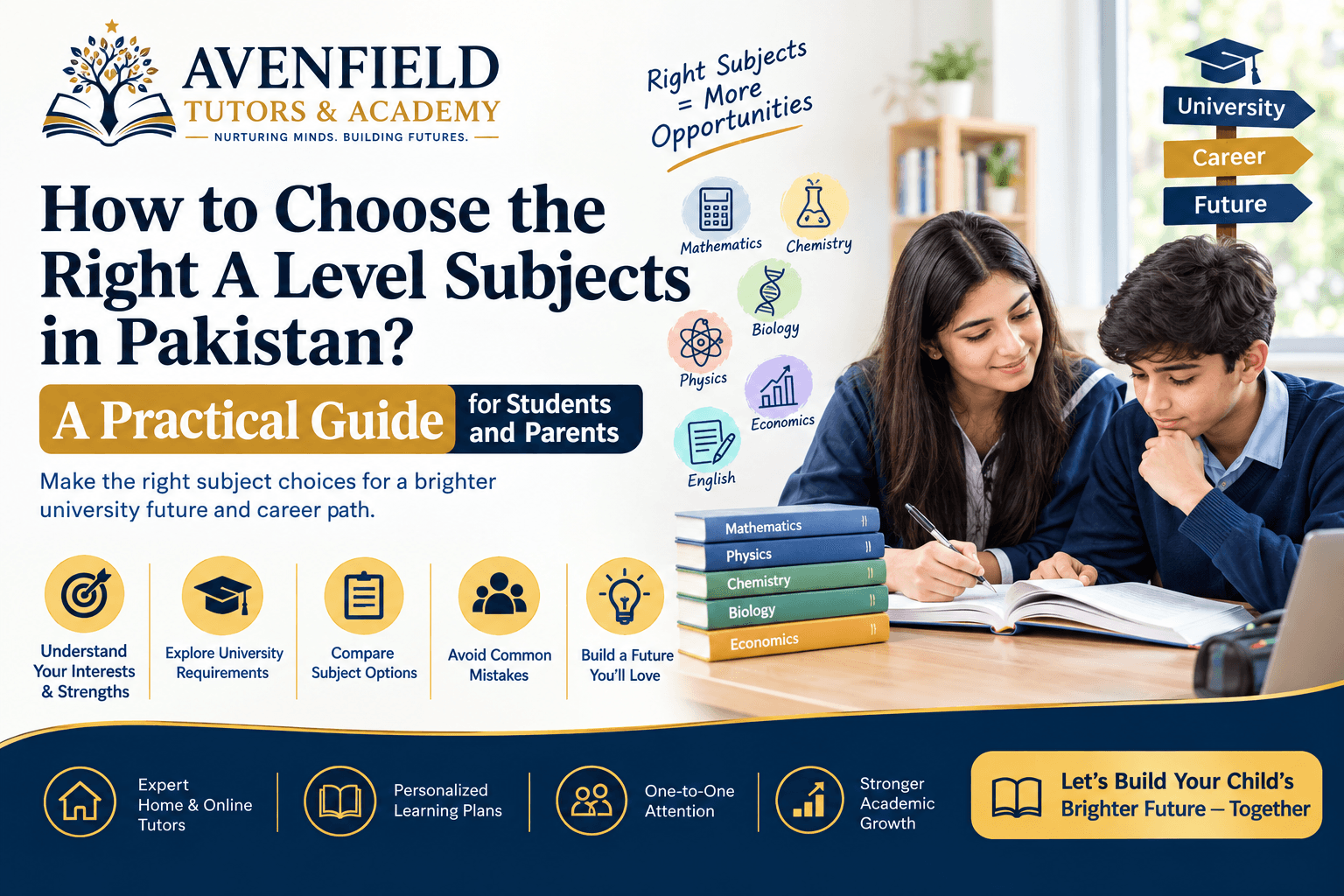
A Level students in Pakistan reviewing subject choices for university and career planning

Choosing A Level Subjects Is a Bigger Decision Than It Looks

Choosing A Level subjects can feel surprisingly difficult. A student may like Biology but also be interested in business. Another may enjoy Mathematics but have not decided whether to pursue engineering, computer science, economics, or something else. Parents often have their own expectations, while schools may recommend combinations based on academic performance.
The problem is not that there are too many choices. The problem is choosing subjects without understanding what each combination means for the next stage of education.
A Level students usually study fewer subjects than they did at O Level, but each subject demands more depth. That is why a subject choice should not be based only on which subjects seem easy or which subjects a friend is taking.
If your child is moving from O Level to A Level, it is also worth understanding how the academic demands change. Our O Level to A Level transition guide explains the difference in workload, depth, and study expectations in more detail.

Start With the University Course, Not Just the Career Name

One of the most common mistakes students make is choosing subjects based on a broad career name such as "doctor", "engineer", "businessman", or "lawyer". The better approach is to work backwards from the degree programme the student may eventually apply for.
For example, a student interested in medicine should not only ask, "Which subjects are good for becoming a doctor?" They should make a shortlist of medical programmes and check the current admission requirements of the universities they may apply to.
The same applies to engineering, computer science, economics, accounting, business, psychology, law, and other fields. Different universities and programmes can have different subject and grade requirements, so there is no single A Level combination that guarantees eligibility everywhere.
Make a simple list before finalising subjects:
  • Possible degree: What university programme might the student study?
  • Required subjects: Does the programme specify particular A Level subjects?
  • Required grades: Are there minimum grades or combinations?
  • Alternative routes: If the student changes direction later, will the subjects still leave reasonable options?
Do this research before the school subject-selection deadline, not after the A Level classes have already started.

How Many A Level Subjects Should You Choose?

There is no universal number of A Level subjects that is right for every student. The appropriate combination depends on the school, the student's academic situation, the intended university pathway, and the amount of workload the student can realistically manage.
Taking more subjects does not automatically make an application stronger. A student who takes an unnecessarily heavy combination and struggles to maintain strong performance may create a bigger problem than a student who chooses a focused combination that fits their academic goals.
Before adding an extra subject, ask whether it is actually required or useful for the student's intended pathway. If it is not, the additional workload may not provide much practical benefit.
Students should also check what their school actually offers. Not every school provides every A Level subject, and some schools have restrictions on which subjects can be combined because of timetable arrangements.

Match Subjects With the Student's Actual Strengths

A subject can look attractive on paper and still be a poor choice for a particular student. A student who wants to study engineering but strongly dislikes problem-solving may need to think carefully about whether they are prepared for the demands of Mathematics and Physics.
Similarly, choosing Biology simply because a student is considering medicine is not enough. The student should also understand what studying Biology at A Level actually involves: detailed content, regular revision, application of concepts, and consistent exam practice.
Look at the student's O Level performance, but do not use grades as the only deciding factor. Also consider:
  • Which subjects does the student understand without excessive memorisation?
  • Which subjects do they enjoy studying for longer periods?
  • Where do they consistently perform well?
  • Do they prefer calculations, scientific concepts, writing, analysis, or discussion?
  • How much independent study are they willing to do?
A realistic subject choice sits somewhere between interest, ability, and future requirements. Ignoring any one of these can create problems later.

Common A Level Subject Combinations for Different Study Paths

There is no single "best" A Level combination for all students. However, some subject groupings are commonly considered when students have a particular academic direction in mind.
Medicine and related fields: Biology and Chemistry are commonly relevant subjects for students considering medical pathways, while Physics or Mathematics may also be relevant depending on the intended programme and university. Students should verify the current requirements of the medical universities they are considering rather than relying on a general subject combination.
Engineering: Mathematics and Physics are commonly important for engineering pathways. Chemistry may be relevant for certain disciplines, while Further Mathematics can be useful where it is available and appropriate for the student.
Computer Science and Software-related fields: Mathematics is often useful for computing-related degrees. Computer Science can provide relevant background where it is available, but students should check the specific admission requirements of their target programmes rather than assuming Computer Science is mandatory everywhere.
Business, Economics, and Finance: Mathematics can be useful for economics and quantitatively focused programmes. Economics, Accounting, and Business Studies may also be relevant depending on the student's interests and university pathway.
Humanities and Social Sciences: Subjects such as English Literature, History, Sociology, Psychology, Economics, and related humanities subjects can provide useful preparation for different social science and humanities degrees.
These examples are starting points, not fixed rules. Before making a final decision, check the exact requirements of the degree programmes your child may apply to.

What If Your Child Has Not Decided on a Career Yet?

This is completely normal. Many students finishing O Level do not have a specific career plan yet. Choosing subjects under pressure simply because everyone else seems certain can create unnecessary stress.
If the student is undecided, focus first on subjects that match their strongest academic areas while keeping realistic future options open. Mathematics, sciences, languages, humanities, and social sciences can lead toward different university pathways, but the exact combination still needs to be considered carefully.
The key is not to keep every possible career open at any cost. That can result in a combination that is too difficult or does not suit the student. Instead, identify two or three realistic areas of interest and check what subjects those pathways normally require.
A useful conversation might be: "You do not have to know your exact career today. Let us first identify the areas you are good at, the subjects you actually enjoy, and the university programmes you might consider."

Do Not Choose a Subject Just Because Your Friend Is Taking It

This sounds obvious, but it happens frequently. A student hears that a friend is taking Economics, Computer Science, Psychology, or Physics and decides to take the same subject without considering whether it fits their own plans.
The same problem occurs when students choose subjects because someone told them that a particular subject is "easy". A Level difficulty is highly personal. A subject that feels straightforward to one student can require significant effort from another.
Your child will be spending a substantial amount of time studying these subjects for at least the next stage of their education. The decision should therefore be based on the student's own abilities and plans rather than their friends' choices.

Consider the Workload Before Finalising the Combination

A Level subjects should be considered as a workload package, not as separate choices. Three individually manageable subjects can become difficult when combined with another demanding subject and a busy school schedule.
Ask the student to think beyond the classroom. A Level study includes homework, revision, coursework where applicable, past-paper practice, tests, and independent reading.
For example, a student choosing several science subjects should be prepared for regular concept revision and problem-solving. A student choosing essay-heavy subjects should be comfortable with reading, writing, research, and structured arguments.
It is also useful to discuss the workload with current A Level students or teachers. They can give the student a more realistic idea of what weekly study actually looks like.

Check University Requirements Before You Finalise Anything

This is the step parents should not skip. Once you have a few possible degree programmes in mind, visit the official admissions pages of the universities you may apply to and check their current requirements.
Do not rely entirely on an old Facebook post, a friend's experience, or a general list found online. Admission requirements can change, and different programmes at the same university can have different requirements.
For students planning to study outside Pakistan, the same principle applies. Check the official requirements of the universities and countries being considered, including subject prerequisites, grades, English-language requirements, and any equivalence or documentation requirements that may apply.
Keep screenshots or notes of the requirements you find. This makes it much easier to compare universities before the final subject-selection decision.

What Parents Should and Should Not Do

Parents naturally want their children to choose subjects that lead to stable and successful careers. The problem starts when parental preference completely replaces the student's own academic strengths and interests.
Instead of saying, "You should become a doctor because it is a good career," ask questions that help the student think through the decision:
  • Which subjects do you genuinely enjoy?
  • Which subjects have you performed consistently well in?
  • What kind of university courses interest you?
  • Have you checked the entry requirements?
  • What workload are you comfortable managing?
  • What alternatives would you have if your interests change?
Parents can provide structure and research support without making the entire decision for the student. The final combination should be realistic for the student who will actually have to study those subjects every week.

When Should You Get Academic Guidance?

If the student is choosing between several pathways and cannot work out which subjects fit, getting advice from someone familiar with the relevant curriculum can be useful.
A qualified tutor can help identify academic strengths, explain the demands of individual subjects, and discuss study expectations. However, tutoring should not replace checking official university requirements.
If your child is already moving into A Level and needs support with the academic transition, our A Level tutor service can be a starting point for finding subject-specific academic support.
Parents who are comparing tutoring options can also read our guide on how to choose the right online tutor, especially if they are considering online tuition for an A Level subject.

A Simple A Level Subject Selection Checklist

Before submitting the final subject choices, sit down with your child and go through this checklist:
  • Academic Strength: Does the student have a reasonable foundation for each subject?
  • Interest: Is the student genuinely interested in studying the subject for the next stage?
  • University Pathway: Have the relevant degree requirements been checked?
  • Workload: Can the student realistically manage the complete combination?
  • School Availability: Does the school offer all the chosen subjects together?
  • Future Flexibility: If the student changes direction, will the combination still leave reasonable options?
  • Support: Does the student know where to get help if a subject becomes difficult?
If you can answer these questions clearly, the subject-selection decision becomes much less about guessing and much more about planning.

How Avenfield Tutors Can Support A Level Students

Once the subjects are selected, the next challenge is actually keeping up with A Level work. The jump from O Level to A Level can be substantial, particularly in subjects that require deeper conceptual understanding and regular independent practice.
Avenfield Tutors provides academic tutoring for students who need additional support with A Level subjects. Parents can explore the verified tutor directory and look for tutors according to subject and academic level.
If you are still comparing tutoring formats, our guide to home tuition vs online tuition explains the practical differences between the two options.
For parents who are also considering the cost of tutoring, our home tutor cost guide explains the factors that can affect tuition fees in Pakistan.

Final Thoughts

Choosing A Level subjects is not about finding a combination that sounds impressive. It is about finding a combination that the student can handle, understands, enjoys enough to study consistently, and that fits the university pathways they may realistically pursue.
Start with the student, research the degree requirements, check what the school offers, and think about the workload before making the final decision.
Most importantly, do not treat subject selection as a decision that has to predict a student's entire life. Students can change their interests and career plans. The goal is to make a well-researched choice that fits the student's current strengths and keeps realistic academic options available.
AT

Written by

Avenfield Tutors Academic Team

O Level, A Level & Test Preparation Consultants

A team of experienced education consultants based in Islamabad, helping students across Pakistan find qualified, verified tutors for school, college, and competitive exams.

How should I choose A Level subjects in Pakistan?▼

Start by identifying the student's academic strengths and interests, then check the current subject requirements of the university programmes they may apply to. Also consider the workload, subjects offered by the school, and whether the combination leaves reasonable options if the student changes direction later.

How many A Level subjects should a student take?▼

There is no single number that is appropriate for every student. The right choice depends on the school, university pathway, academic ability, and workload the student can realistically manage. Students should check the requirements of their intended programmes before adding extra subjects.

Which A Level subjects are suitable for medical students?▼

Biology and Chemistry are commonly relevant to medical pathways, while other subjects such as Physics or Mathematics may also be relevant depending on the programme. Students should always check the current admission requirements of the medical universities they are considering.

Which A Level subjects are useful for engineering?▼

Mathematics and Physics are commonly important for engineering pathways. Chemistry, Further Mathematics, or other subjects may also be relevant depending on the engineering discipline and university. Students should check the specific requirements of their target programmes.

Can I choose A Level subjects if I have not decided on a career?▼

Yes. Many students have not decided on a specific career after O Level. In that situation, focus on subjects that match the student's strengths and interests while keeping realistic university options open. Researching two or three possible study areas can help narrow the choices.

Should parents choose A Level subjects for their child?▼

Parents should be involved in the decision, particularly when researching university requirements and workload, but the student's academic strengths and interests should also be considered. The student is the person who will have to study the chosen subjects consistently, so their suitability for the combination matters.

Where can I find an A Level tutor in Pakistan?▼

Parents can explore the Avenfield Tutors directory to find tutors and compare their subject expertise, academic level, and teaching experience. Students can also consider whether home or online tuition better fits their learning needs and schedule.

Ready to put this into practice?

Browse verified tutors on Avenfield and book your first session via WhatsApp – no long forms, no waiting.

💬 Need help? Chat with us